A Blueprint in the Water: How Harris Creek's Restoration Legacy Is Reshaping Estuaries Across America
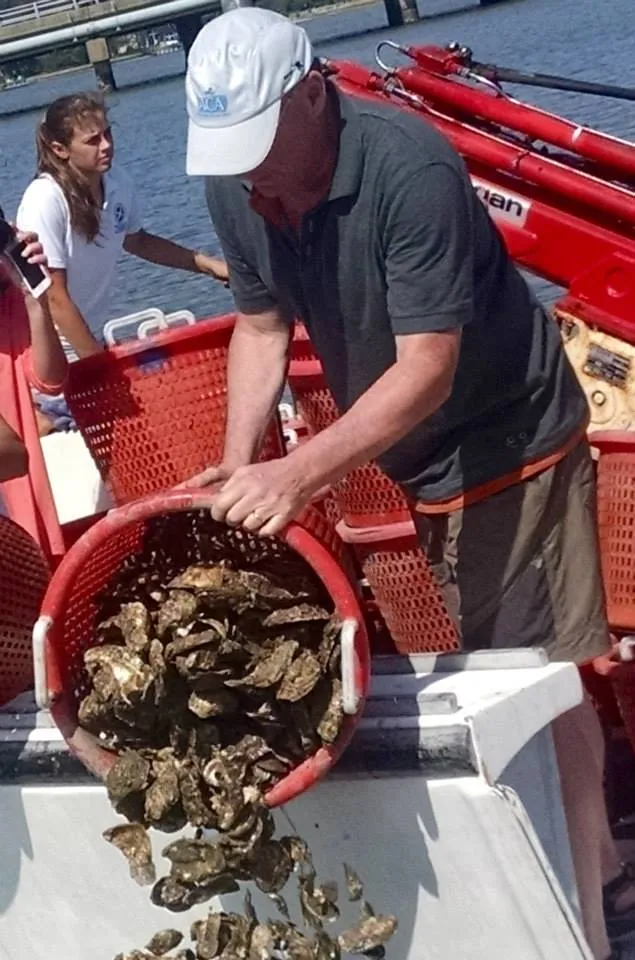
Photo: Office of Senator Tim Kaine, Public domain, via Wikimedia Commons
There is a particular kind of pride that comes from watching something you helped build become a template for others. For the oyster farmers, marine scientists, and conservation advocates who spent years coaxing life back into Harris Creek on Maryland's Eastern Shore, that pride has recently taken on a broader dimension. The Chesapeake tributary, once so depleted that its oyster population had fallen to less than one percent of its historic levels, is now being cited in restoration planning documents from Apalachicola Bay to Puget Sound.
The question driving researchers and practitioners alike is both simple and demanding: can what worked in the Chesapeake work elsewhere?
The Harris Creek Model, Defined
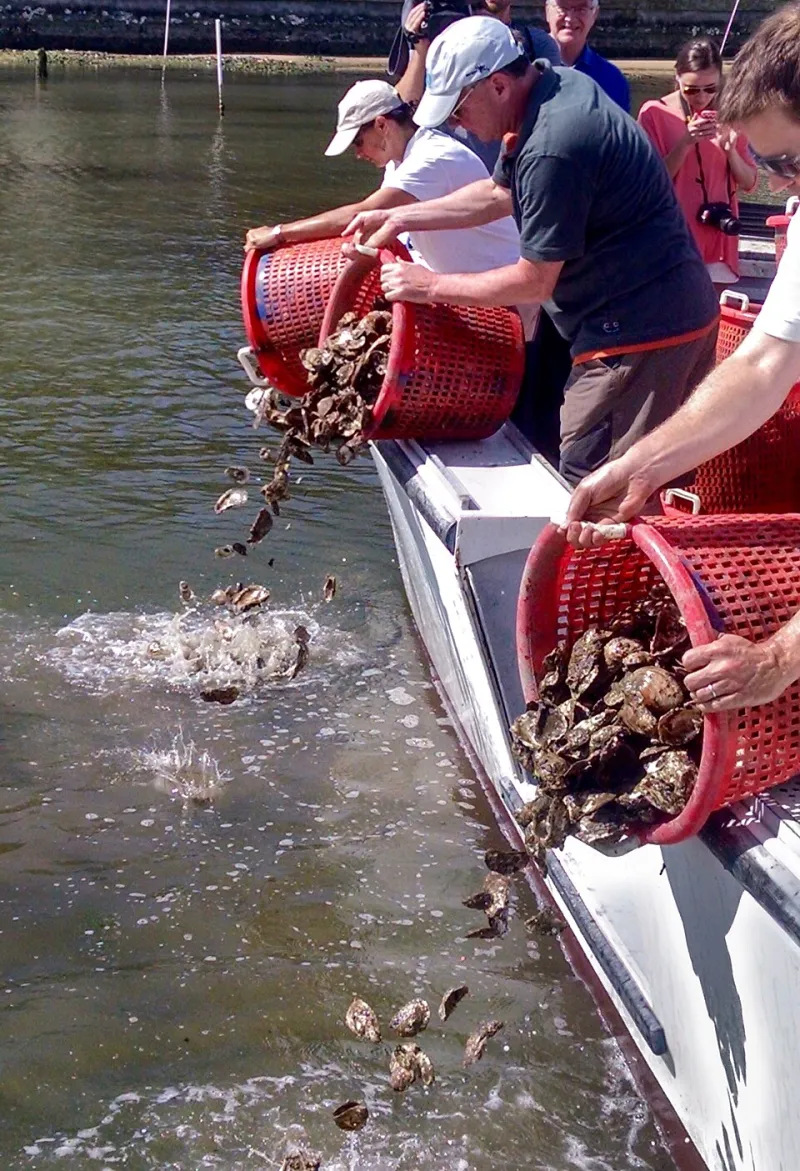
Before examining how this model travels, it is worth articulating precisely what it consists of. Harris Creek's restoration success rested on several interlocking strategies. Shell recycling programs returned cultch — the hard substrate that oyster larvae need to attach — to the creek bottom at scale. Aquaculture operations provided both economic incentive for local stewards and a source of spat for wild reef rebuilding. Regulatory protections established sanctuary zones where harvesting was prohibited, allowing populations to reproduce without interruption. And sustained water quality monitoring ensured that the biological gains were not quietly eroded by nutrient pollution.
No single element was sufficient on its own. The model's power derived from the integration of all these components, coordinated across government agencies, private farmers, and nonprofit organizations. That coordination, several restoration ecologists note, is often harder to replicate than any individual technique.
Gulf Coast Adaptations: Promise and Patience
Along the Gulf Coast, oyster restoration has become an increasingly urgent conversation in the wake of cumulative stressors: hurricane damage, freshwater diversions, disease pressure, and the lingering ecological shadow of the 2010 Deepwater Horizon oil spill. In Apalachicola Bay, Florida, where the eastern oyster fishery collapsed dramatically in the early 2010s, restoration practitioners have turned to Harris Creek's sanctuary model as a conceptual anchor.
"We looked at what the Chesapeake achieved and recognized that the principle — giving reefs protected space to recover — was transferable, even if the specific biology differs," said one marine restoration specialist working with a Gulf Coast conservation organization. The differences, however, are not trivial. Gulf oysters experience higher temperatures, more variable salinity regimes, and distinct disease pressures compared to their Chesapeake counterparts. The Dermo parasite, Perkinsus marinus, is present in both regions, but its virulence intensifies in warmer waters, complicating the timeline for reef recovery.
Despite these challenges, early results from pilot sanctuary zones in Florida and Alabama have been encouraging. Reef structure is rebuilding in areas where it had been absent for decades, and researchers are documenting the return of associated species — juvenile fish, blue crabs, and various invertebrates — that depend on reef habitat. The lesson drawn from Harris Creek, that patience is as essential as technique, has become something of a governing philosophy.
The Pacific Northwest: A Different Oyster, A Shared Logic
In the Pacific Northwest, the oyster story involves different species and different pressures, yet the influence of Chesapeake restoration thinking is nonetheless visible. Washington State's shellfish industry, centered on Willapa Bay and Hood Canal, has long been a commercial powerhouse, but restoration of wild native Olympia oyster (Ostrea lurida) populations has emerged as a distinct conservation priority.
The Olympia oyster, the only oyster species native to the Pacific Coast, was nearly extirpated from much of its historic range by the early twentieth century due to overharvesting and habitat degradation. Restoration practitioners working on its recovery have drawn explicitly on the eastern oyster's comeback narrative — including Harris Creek — to make the case for long-term investment in reef rebuilding.
"The Chesapeake experience gave us a credible proof of concept," explained a restoration biologist affiliated with a Pacific Northwest shellfish conservation program. "It demonstrated to funders, to regulators, and frankly to skeptics that oyster reef restoration at meaningful scale was achievable within a human lifetime."
The Pacific Northwest work faces its own region-specific complications, including ocean acidification — a more acute threat in Pacific waters than in the Chesapeake — and the complex relationship between native Olympia oysters and the commercially dominant Pacific oyster (Crassostrea gigas). Navigating those dynamics requires locally tailored solutions, but the foundational logic of the Harris Creek model — protect, rebuild, monitor, sustain — remains legible across the geographic distance.
Long Island Sound: Urban Pressures, Coastal Ambitions
Perhaps nowhere is the challenge of replication more complex than in Long Island Sound, the semi-enclosed estuary separating Connecticut from New York. The Sound supports a meaningful oyster industry, particularly in Connecticut, but its waters bear the accumulated burden of nitrogen pollution from one of the most densely populated coastal corridors in the United States. Hypoxic zones — areas of dangerously low dissolved oxygen — have historically stressed or killed bottom-dwelling organisms, including oysters, in the Sound's western reaches.
Restoration advocates in the region have studied Harris Creek's water quality monitoring and nutrient reduction frameworks carefully. The insight that oyster restoration and watershed management must proceed in tandem, rather than in isolation, has shaped how Connecticut and New York agencies approach their own estuary planning.
Local shellfish farmers in the Sound have also embraced a version of the aquaculture-as-stewardship ethos that characterizes the Chesapeake model. Oyster farming operations in Westport and Norwalk, Connecticut, for example, have positioned their work explicitly in terms of ecological service — emphasizing the water filtration capacity of their crops and partnering with municipal programs to recycle shells back into the Sound.
What Travels and What Does Not
For all the enthusiasm surrounding Harris Creek's influence, experienced restoration practitioners are careful to distinguish between inspiration and prescription. The specific conditions of the Chesapeake — its salinity gradients, its disease ecology, its regulatory history, its community of dedicated stakeholders — cannot simply be transplanted to another estuary.
What does travel, these experts suggest, is a set of principles: the importance of sanctuaries, the value of shell recycling, the necessity of integrating aquaculture with wild reef recovery, and above all the understanding that restoration is a decades-long commitment rather than a project with a defined endpoint.
Harris Creek's most enduring contribution to the national restoration conversation may be precisely this: it proved that commitment, sustained across administrations and funding cycles and public attention spans, yields results that shorter-term interventions cannot. For coastal communities from Louisiana to Oregon, that proof matters enormously.
A Living Curriculum
At Harris Creek Oyster, we are accustomed to thinking about what the water gives us — the briny, mineral-rich shellfish that arrive at our tables carrying the particular character of the Chesapeake. But it is worth pausing to consider what Harris Creek gives back to the broader coastal world: a living curriculum in the art and science of restoration, written in shell and water and time.
The estuaries studying this curriculum are diverse, and their adaptations will be necessarily imperfect. That is the nature of ecological work. But the fact that Harris Creek's story is being read in Gulf Coast oyster bars, Pacific Northwest research stations, and Long Island Sound shellfish operations speaks to something larger than regional pride. It speaks to the possibility, demonstrated in the tidal waters of Maryland's Eastern Shore, that degraded places can be remade — and that the oyster, patient and filtrative and architecturally generous, is a worthy partner in that work.