Water, Salt, and Time: The Elemental Forces That Define Harris Creek Oyster Flavor
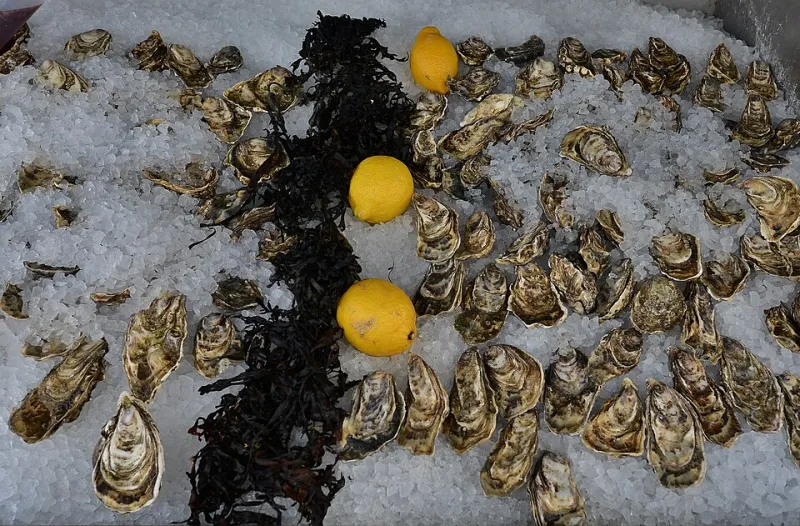
Photo: Michael Garlick , CC BY-SA 2.0, via Wikimedia Commons
Place a freshly shucked Harris Creek oyster on your tongue and you will encounter something that resists simple description. There is brine, certainly — a clean, assertive salinity that recalls the open water. But beneath that initial impression lies a layered complexity: a mineral coolness, a gentle sweetness, and a long, oceanic finish that lingers well after the shell has been set aside. That depth of flavor is not a matter of culinary technique. It is the direct expression of a place.
In wine, the French call this phenomenon terroir — the idea that soil, climate, and geography imprint themselves upon what is grown there. Oyster farmers and marine scientists have long recognized that the same principle applies to bivalves, perhaps even more transparently than it does to grapes. Harris Creek, a tributary nestled within Maryland's Chesapeake Bay watershed, offers one of the most distinctive and consistent expressions of aquatic terroir found anywhere along the Eastern Seaboard.
The Role of Salinity: More Than Just Salt
Salinity is the most immediately perceptible dimension of oyster flavor, and Harris Creek's water chemistry is particularly well-suited to producing oysters with a balanced, refined brine. The creek sits at a transitional zone where freshwater input from Maryland's interior watersheds meets the saltier influence of the mid-Bay. This mixing creates what marine biologists refer to as a mesohaline environment — a zone of intermediate salinity, typically ranging between 10 and 18 parts per thousand depending on season and rainfall.
This range is consequential. Oysters grown in water that is too saline can develop an overwhelming, one-dimensional saltiness. Those raised in overly fresh conditions may taste flat or muddy. The mesohaline sweet spot of Harris Creek produces oysters with a salinity level that is present and identifiable without dominating the palate, allowing secondary flavor notes to emerge alongside it.
Dr. Lisa Hargrove, a marine biologist affiliated with a Chesapeake Bay research consortium, explains it this way: "Salinity affects not just taste but the physiology of the oyster itself. At intermediate salinity levels, Crassostrea virginica — the Eastern oyster — tends to grow more slowly and accumulate glycogen at a higher rate. That glycogen is what you're tasting as sweetness. It's the oyster's energy reserve, and in balanced salinity conditions, it builds up beautifully."
Mineral Content and the Geology Beneath the Water
Beyond salt, the mineral composition of Harris Creek's water contributes a subtle but unmistakable character to the oysters raised within it. The Chesapeake Bay watershed draws from a diverse geological base — sedimentary formations rich in calcium, magnesium, and iron — and these elements are carried into the water column through runoff and tidal exchange.
Calcium, in particular, plays a structural and flavorful role. It is the primary building block of the oyster's shell, and its concentration in the water influences both the density and the taste of the meat itself. Harris Creek oysters are frequently noted for a clean mineral finish — what enthusiasts sometimes describe as a "wet stone" quality — that reflects the calcium-rich environment in which they mature.
Magnesium and trace elements contribute additional complexity, lending a subtle earthiness that distinguishes these oysters from those harvested in more geologically uniform coastal environments. When tasting a Harris Creek oyster alongside, say, a Pacific Northwest variety or a Gulf Coast specimen, the difference in mineral character becomes readily apparent to an attentive palate.
Temperature Fluctuations and Seasonal Flavor Shifts
The Chesapeake Bay is not a static environment. Water temperatures in Harris Creek vary considerably across the year, dropping into the low 40s Fahrenheit during winter months and climbing into the upper 70s by midsummer. These fluctuations have a profound influence on oyster flavor and are one reason that many connoisseurs insist on the old adage favoring months with the letter "R" — September through April — for oyster consumption.
During colder months, oysters slow their metabolic activity and accumulate glycogen reserves, resulting in plumper, sweeter meat with a firmer texture. As water temperatures rise in late spring and summer, the oysters enter their spawning cycle. During this period, stored glycogen is redirected toward reproduction, and the meat can become softer, milkier, and less concentrated in flavor.
James Whitfield, a third-generation oyster farmer who has worked Harris Creek for over two decades, describes the seasonal arc with characteristic precision: "Winter oysters from here are some of the most satisfying you'll find — dense, cold, and sweet with a long finish. By July, they're a different animal entirely. Not bad, but softer. The creek tells you when it's time."
For consumers seeking the most expressive version of Harris Creek's flavor profile, late autumn and early spring represent peak windows. The oysters are fully recovered from any summer spawning activity, water temperatures have dropped sufficiently to concentrate their meat, and the mineral notes are at their most pronounced.
The Living Ecosystem: Phytoplankton and the Flavor Factory
No discussion of oyster flavor would be complete without addressing what oysters actually eat. As filter feeders, oysters draw water continuously through their gills, extracting phytoplankton, dissolved organic matter, and microalgae. The composition of this food source varies by location and season, and it contributes meaningfully to the flavor of the finished product.
Harris Creek benefits from a relatively productive phytoplankton community, supported by the nutrient dynamics of the Chesapeake watershed. Certain algal species — including diatoms and dinoflagellates common to the mid-Bay — impart subtle grassy, oceanic, or even faintly buttery notes to the oysters that filter them. This is the aquatic equivalent of pasture-raised livestock: the quality and diversity of the diet leaves a discernible mark on the flavor.
Marine ecologists have noted that Harris Creek's position within a relatively well-managed section of the Bay — with ongoing restoration efforts targeting water quality and submerged aquatic vegetation — supports a more diverse and stable phytoplankton population than is found in more degraded estuarine zones. That ecological health translates directly into flavor complexity.
Tasting What the Water Knows
For the home consumer or restaurant guest encountering Harris Creek oysters for the first time, understanding this scientific foundation transforms the tasting experience. Rather than simply registering "salty" or "fresh," one can begin to read the oyster as a record of its environment — an edible document of salinity, temperature, mineral content, and biological community.
Begin by noting the initial brine: is it sharp and assertive, or does it arrive gently? Follow it with attention to sweetness — that glycogen signature — and then the finish, where mineral and oceanic notes tend to linger. With practice, the distinctions between a November harvest and a March harvest, between a drought year and a wet one, become legible in the shell.
This is the true meaning of eating locally and seasonally. A Harris Creek oyster does not merely come from a place. It is that place, translated into something extraordinary by water, salt, and time.